Geometry for a Spin Lattice on Quantum Computers - Paper
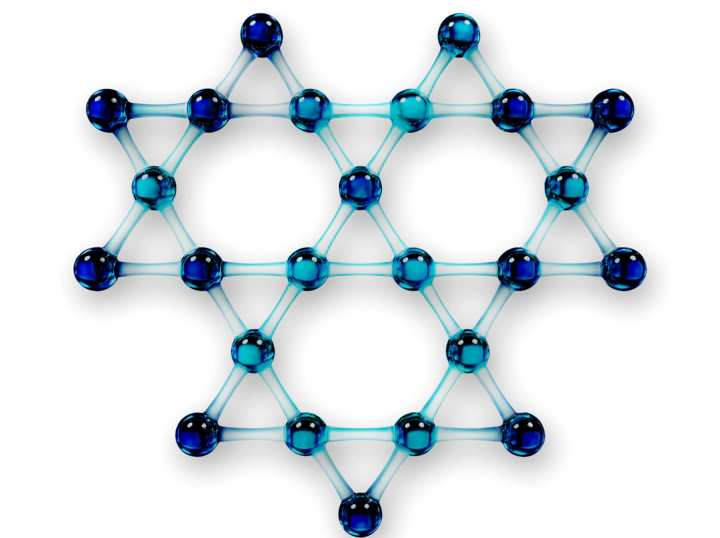
Quantum magnets are fascinating. They present intriguing structures and patterns that cannot be understood with classical physics. When a material combines many-body interactions, lattice topologies, and the quantum properties of spin, finding ground states for the system becomes a hard task. The problem’s difficulty remains whether the desired solution is analytical or numerical. Many such problems are classified as “Quantum Merlin-Arthur” (QMA), which form a family of problems that are believed to be hard even for quantum computers.
Solving these problems variationally is akin to a blind man searching for a water source in a desert landscape of plateaus and valleys. Our team at CQTech, in collaboration with Dr. David E. Bernal Neira from SECQUOIA at Purdue University, has recently published a Physical Review Research paper titled “Probing the ground state of the antiferromagnetic Heisenberg model on the kagome lattice using geometrically informed variational quantum eigensolver”. The paper explores how to obtain relevant information about the energy landscape of a spin-½ quantum lattice system governed by Heisenberg interactions.
Navigating the Energy Landscape
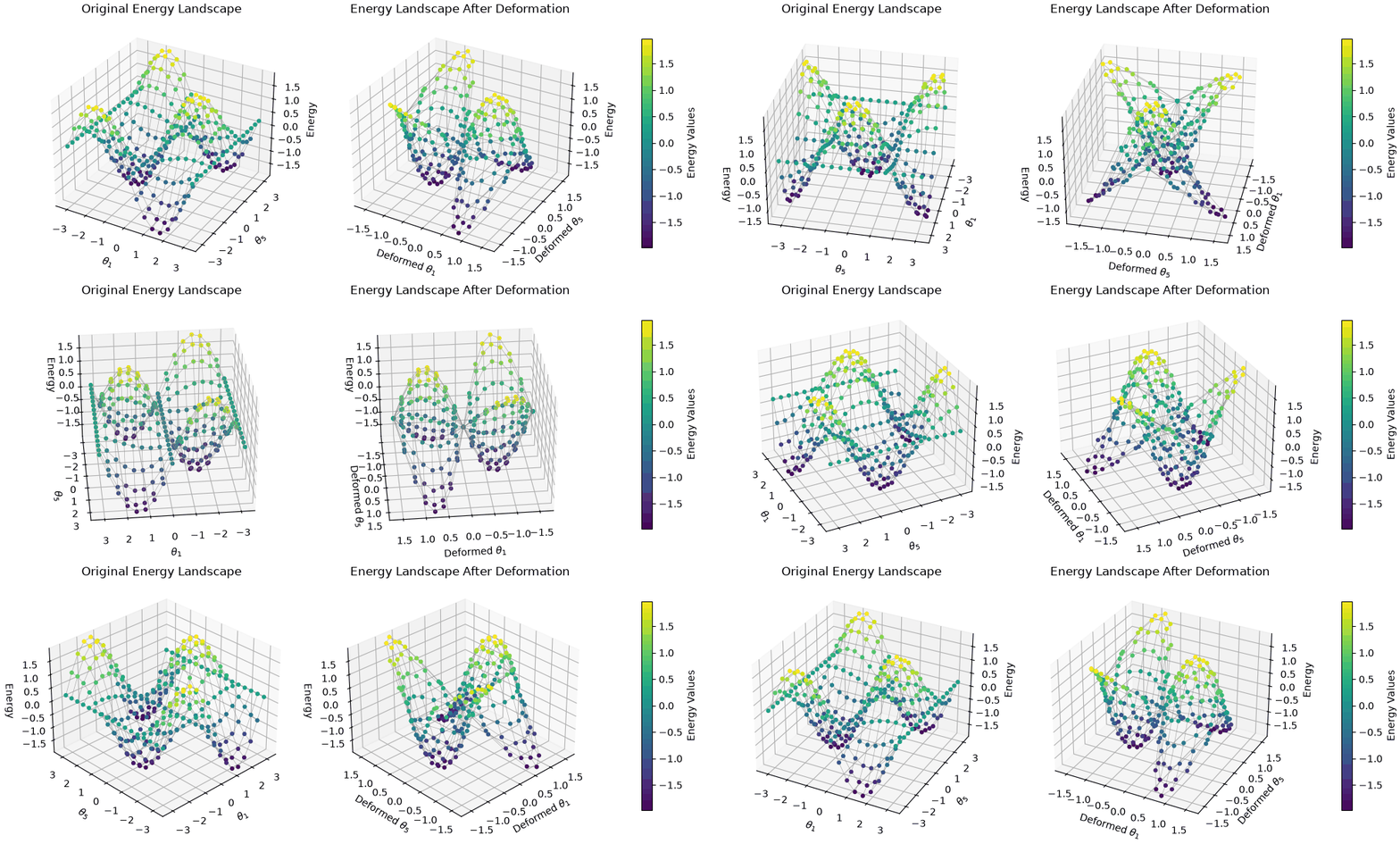
The study covers two levels of geometry exploration. The first tackles the geometry of the variational wavefunction subject to optimization. Accounting for the geometry of the space of parameterized wavefunctions makes optimization easier when that space can be meaningfully squeezed, therefore restricting us to navigate smaller, more interesting regions, instead of unnecessarily large ones.
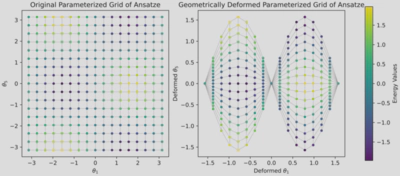
The second level relates to the energy landscape of the Hamiltonian. Further geometrical considerations in that landscape add flexibility to the variation step using Armijo’s principle, which gets further information about the steepness of the energy landscape at any specific position during optimization. The study shows that the Armijo principle can give us precious information–with a small cost overhead–to help navigate the landscape more quickly while still ensuring that the blind man doesn’t pass by and miss the water source
On Noise-Resilience
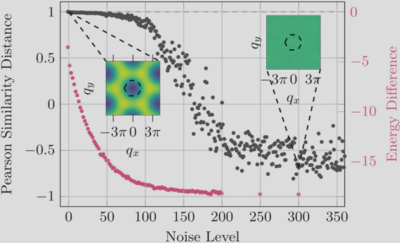
Beyond the optimization, the paper sheds light on the measurement accuracy problem in noisy quantum hardware. As energy measurements are not accurate and require potentially costly error mitigation–generally without rigorous guarantees on the results’ correctness–the study turns our attention to a class of measurements that is more noise-resilient. These observables are also of greater physical interest, and focusing more on them renders quantum hardware experiments more valuable and meaningful to physicists working on quantum many-body problems.
Full paper: Probing the ground state of the antiferromagnetic Heisenberg model on the kagome lattice using geometrically informed variational quantum eigensolver
Supplementary data and code: https://doi.org/10.5281/zenodo.21264601
