A Practical Guide to VQE: From Molecular Encoding To Quantum Hardware - Paper
The CQTech team is happy to share that our VQE study paper, “Ground State Energy Estimation on Current Quantum Hardware Through The Variational Quantum Eigensolver: A Practical Study”, has been published in the Journal of Chemical Theory and Computation. It is in open access, and you can read it here. The paper is accompanied by an extensive supplementary material that covers, in detail, molecular chemistry and quantum mechanics computations, as well as implementation codes.
Quantum Chemistry and the Variational Quantum Eigensolver
One of the central goals in computational chemistry is the accurate estimation of a molecule’s ground-state energy. This observable is essential for understanding chemical bonding, reaction dynamics, and material properties. While this might seem straightforward, the underlying quantum systems are highly entangled, and their associated Hilbert spaces grow exponentially with system size. In particular, the latter makes the problem hard for classical computers in the general case. This is where quantum computing offers a promising path forward.
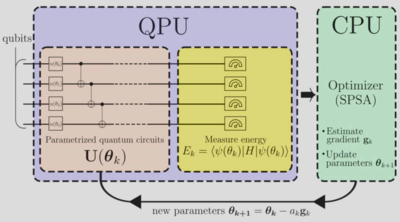
Among the most prominent algorithms designed for current quantum hardware is the Variational Quantum Eigensolver (VQE). The VQE is a hybrid quantum-classical algorithm built on the Rayleigh-Ritz principle and the variational method. It combines a parametrized quantum circuit, called an ansatz, with a classical optimizer that iteratively adjusts the parameters to minimize the energy expectation value. The quantum computer evaluates this expectation by preparing the ansatz and performing measurements, while the classical computer guides the search toward the ground state.
Our Work: From Basic Theory to Real Hardware
In our study, we present a detailed, tutorial-like presentation and implementation of the VQE for estimating molecular ground-state energies on current quantum computers. This includes:
- encoding the chemical problem onto a quantum computer,
- choosing suitable ansätze and optimization strategies,
- dealing with noise and hardware limitations,
- and, analyzing convergence and performance trends.
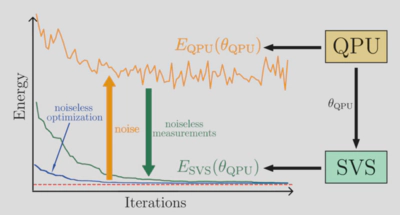
Finally, we run the algorithm on the IBM Fez quantum computer, and we provide a performance analysis which, among other things, focuses on the often overlooked accuracy of the obtained ground state, as opposed to its associated energy. We show that although noise affects the energy significantly, its effect on the optimized ground-state parameters is much smaller.
Full paper: Ground State Energy Estimation on Current Quantum Hardware Through The Variational Quantum Eigensolver: A Practical Study
Supplementary information: https://pubs.acs.org/jctcce/article-supplement/3693289/pdf/ct4c01657_si_001/
